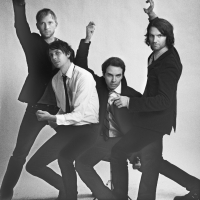
Violens
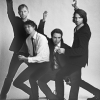
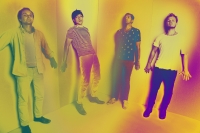
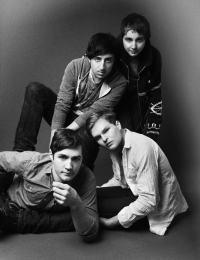
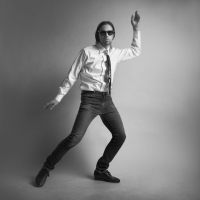
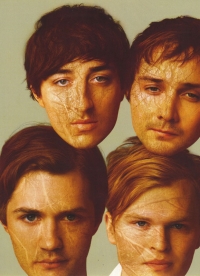
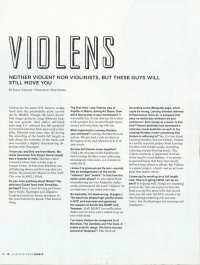
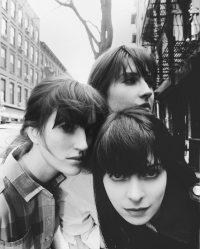
November 10th, 2008The other night I was at a dinner party, talking about a recent foray into rock photography. The topic quickly became more broad, oriented toward a scene or movement rather than a particular band. We talked about arch irony and musical virtuosity, about the educated rocker or the cerebral rocker. We discussed Ween, MGMT, Of Montreal and, the catalyst for the conversation, Violens, the first band I ever photographed (a couple of weeks ago, Oct. 23rd). After a while of musing on cerebral rock in general, the conversation went back to the band Violens, their musical capacity to be chameleons, to play in any style they like, and the possibility that, though they’re quite dark in mood at the moment, their name may well have come from comedy, particularly Gilda Radner’s famous “Violins on TV” skit from the early days of Saturday Night Live. This is just the sort of texture present in so much of what is happening right now, a strange wink behind every angle. Lastly, phonetic ambiguity is a cherished past time of this writer. It’s as important to rock n’ roll as it is to comedy, and I wanted to post the clip here.
Improvements on Cat Photography
July 30th, 2008
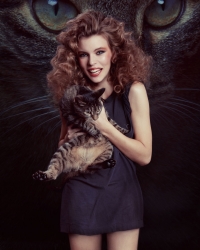
I’m pretty sure the first thing my dad did when he got his first decent camera in 1976 was shoot pictures of cats. I have these big prints somewhere. They were shot with a 50mm macro, and, for whatever convoluted reason my dad enlarged the snapshot prints via some old fine art camera, the kind of vacuum system and attached camera art directors used to use to make composites, etc. I was born in 1976, so it wasn’t for a few years that my dad ever showed me these prints, but I remember them well, including details of their production, because of the way he presented them to me. He was very covert and conspiratorial about showing them.
I remember in the same viewing, my dad also showed me an enlargement of a fifty dollar bill which he’d produced the same way. And I remember him telling me it’s illegal to photograph money, or, at least, highly suspect to do so in the company of all sorts of pre-press, press and photographic reproduction equipment. Note, my dad was not a counterfeiter. I think he just liked fine art cameras?
So, there we were, looking at these gnarly, enlarged close-ups of the cats I’d grown up with alongside illicit photo enlargements of currency. I can’t remember the exact place, the room, but I was young and it made an impression.
I guess it was that moment in my history that ruined conventional cat photography for me? I feel like I can’t look at a cat photograph without wanting all sorts of post production tricks added.
Is it just me or is cat photography a thousand times better solarized?
Song Writing: The Hypnotic I/You Shift
July 30th, 2008Sometimes when I know I should be thinking about pictures, making plans, storyboarding, all that kind of stuff, all I can think about are the details of other occupations. Song writing has been on my mind, something I once considered a serious hobby but haven’t practiced for years.
The other day I went to Ugly Luggage to have a coffee break with James. Steve was there, and he’d decided scale back being a gun for hire in touring rock bands and start writing his own songs. Steve had studied business at NYU before getting into music, so I figured it wouldn’t be off base to discuss some correlations in language I’d noticed from my time working in marketing and studying its craft: I’d noticed that many songs were written like well crafted sales pitches in that they often relied on infinitive language. Steve and I specifically discussed this aspect of song writing that day, and, from there on, I’ve kept noticing things within songs that correlate with marketing theory. I keep thinking of all these little song writing tactics and wanting to share. I’ll do another post on the infinitive in song lyrics. For now I want to talk about another song.
“Wanted Dead or Alive” by Bon Jovi is a song that really gets me. I’m not trying to be funny. I think it’s a powerfully moving song to the point where I kind of black out as I listen. (And, yes, I think it’s also silly.) There are lots of reasons for its power, but the one I’ve been thinking about, as it relates to song writing, is what we used to call in marketing the hypnotic I/you shift. I’m not an expert in marketing language, I was a designer and language was never my area of expertise, but I was aware of it, and I was always convinced of its power. I just never happened to notice it in songs; I was likely too busy going into song trance.
Don’t ask me why the I/you shift is hypnotic or entrancing or powerful. I just don’t know. I only know enough to know it is for some reason. And it’s so simple, so common, I hardly notice when it happens. Like all hypnosis, can happen in everyday language without the conscious knowledge of the speaker or the audience. I suppose that’s what’s happening in “Wanted Dead or Alive.” I suppose Jon Bon Jovi, or whoever wrote the song, wasn’t saying, hey, let’s employ a subtle I/you shift within the narrative of the song to increase the song’s power. I speculate that it just happened for Jon Bon Jovi like it happens in campfire storytelling and they just benefited from its power. They used a tool without recognizing the tool.
So, I remembered today that Bon Jovi was asked to re-write “Wanted Dead or Alive” as part of the original score to a movie called Young Guns 2. The song they came up with is called “Blaze of Glory” and it’s not half as entrancing as “Wanted Dead or Alive.” I feel comfortable suggesting it’s because they accidentally tapped into the power of the hypnotic I/you shift on the first and didn’t know to re-utilize it on the second.
Of course, “Blaze of Glory” was a big hit for Bon Jovi, but so what? It’s second rate. I’ll stand up for “Wanted Dead or Alive,” and that’s about the only Bon Jovi song I’d ever discuss within the limits of Brooklyn.
That YSL Men’s Video I’ve Been Talking About
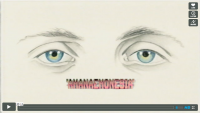
July 10th, 2008I’ve talked about this video a few times with people because it seems so much in the mind of what I went through in art school, only with a few major differences. It’s like an art school high ideal, and when I watch it, all these feelings and memories come up, but there is something in the realization of the piece that feels flat. The feeling I get is this video wasn’t meant to be realized.
I think what I’m getting at is, all those videos we made in video class were aspirational. The aesthetics pointed toward a horizon none of us though we’d reach or could reach. We were fooling around with all these tools, playing tricks with beauty and time and authority and history, all that kind of stuff, but ours were ignorant approximations. Our environment was small and fragmented, and we felt small, which was a nice feeling now that I look back. Seeing this video, which rifs on art video, but which contains the absolute most beautiful faces the world has to offer makes me nervous. It makes me feel the world is small rather than the other way around. It’s not representing beauty in some rag-tag, figurative way, it’s defining it.
This is not a criticism of YSL, good or bad. I’m talking about personal history here, personal feelings. I like this YSL video quite a bit, and if I ever come to a point where I can actually buy clothes, maybe I’ll remember them and buy some? Maybe in ten years all the kids I studied art with will be wearing YSL because this video reminded them of a time when they felt small in relation to the world and that feeling, in retrospect, was awesome?
Is Lanvin’s Alber Elbaz Real?
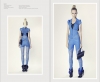
July 6th, 2008There are a number of things in Elbaz’s presentation of which young contendenders may store away for later reference. Most notably, he’s exceptionally affirmative; he notes more what his collection is rather than what it’s not. This may not seem like much, but next time you have a free moment, ask an associate something general such as, “what’s worth liking now?” or “what’s good?” Finding answers regarding what’s not good, what one doesn’t like, what one isn’t about, are far more common than the opposite. One is hard pressed to get an affirmative out of someone. Somehow noting what one doesn’t like has become an acceptable perversion of questions requiring an affirmative answer, to the point where affirmative counterparts are no longer even expected, much less primary.
It’s also really telling what Elbaz says about Acne Denim. He notes the rarity of their can-do attitude.
Last night I asked Mary Ping what’s good and we both agreed Alber Elbaz is good. She told me about some cool NY Times interview which I haven’t read yet. I’ll have to get back to you on that one.
Quantity over Quality
June 27th, 2008
I’ve made it clear to myself that the reason I often enjoy fashion over art is, fashion isn’t burdened by a critique imperative. In other words, art has been academicized to the point where, if it’s not as articulate as a New Yorker article, it no longer meets the bar. These days art = educated. Fashion, on the other hand, is a good bit more nebulous, at least in the way it’s held in our collective imagination. This informs how we experience it.
With this freedom from critique in fashion there are drawbacks. One that always gets me is the abundance of qualitative response. “I hate it,” seems to be the most common refrain among the industry participants. “I don’t like it,” is a close second. And it’s perfectly acceptable to go on like this. It can be so moody!
I’ve heard my fine art friends go on like this, but it’s not serious, rather, it’s just a flamboyant way of calling attention to a quantitative critique. “I hate Picasso,” must be followed by a somewhat-serious, quantitative justification: “His distortions of human anatomy are inconsistently skewed, with portrayals of boobs more rigorously rendered than bellybuttons.” It’s critique because it comes via critical observation. One must have gone to Picasso’s work and observed this disproportionate attention to boobs over bellybuttons to make this statement. The lead-in “I hate” is just an exercise of an idiom; it’s similar to saying “like” or “you know” during conversation.
Competition Paradox
June 25th, 2008
I was thinking the other day about paradox in the restaurant business and how it correlates with the photo business.
The lesser paradox that excites me is this idea that one gets better service when a restaurant is crowded than when it’s not. In my experience this is invariably true. I have to psyche myself up to go to a restaurant that isn’t busy; I have to practically zen out to tolerate the bad service and bad food! When a restaurant is busy, I don’t know exactly why, but the overall machinery works better despite my being surrounded by competing customers.
This may be a stretch–and I hope it is, because that’s how I operate–but the photo industry today feels something like a crowded restaurant. Technology has almost overnight broken the old barriers concerning the means of production and the means of distribution. Any idiot can buy a DSLR for less than a grand and make stunning pictures straight out of the box. And they are! Everyone’s got one.
I went to a wedding a few weeks ago and counted 5 full frame DSLRs and countless point and shoots. At my wedding in 2001 there was a Hasselblad and a punch bowl full of disposable cameras. There was absolutely no question about where the better pictures would come from back then. These days it’s anyone’s guess. Funny thing is, despite an incredibly crowded playing field, I’ve never experienced so much collective excitement over photography and never received so much attention for it.
Sometimes I reason that maybe because photography is, at this moment in time, a vanguard medium again, I’m getting the benefit of the doubt, the way historical vanguardists have. Nobody knows if what I’m doing is any good, or if what anyone’s doing is any good, so we have to pay respect to all of it and defer judgment.
Go into any popular night club in NY and you’ll see at least two night-life documentarians. You’d better make the good photo faces for both of them, because you just never know. Are you a celebrity? Probably not, but you’re fodder for a new medium which grants growing power to anyone willing to shell out the one time fee.
The correlating restaurant paradox I like to contemplate more is the one that suggests the more restaurants that open on any given street, the better they all do, despite the competition. I’m not one to try to explain the “restaurant row” phenomenon, I just contemplate these situations to make myself feel good.
I have a friend James, a respected photographer (semi-retired) who’s refrain to me of late has been, “But Tom, there are so many photographers. Everyone we know is a photographer.” He’s right, my community is a photographers row, James and his obligatory G9 included. Though, it hasn’t made any difference in terms of response.
In the past 5 years I’ve completed numerous projects of serious artistic merit, many in fields which are relatively free of significant competition. Of the three screenplays I finished, exactly one person read one of them. Exactly zero people read the novel I wrote, though I forced a few friends to give feedback on small sections. A negligible number of people have seen my paintings, which took more time from my life than I’m willing to admit. Nobody other than media bosses ever looked twice at my graphic and info design; it was just a means to an end. But, despite the precipitous competition, people respond to my photo work.
I don’t think it speaks to the quality of my work that I get attention in this crowded medium. I’m convinced I’m not a better photographer than I am a painter, for example. I don’t think people know or care what quality is. In some ways, I can begin to feel like I don’t know or care, either. We must give the benefit of the doubt to this new medium, rather, this new means of production/distribution. It probably doesn’t amount to a hill of beans that my first pictures were shot on film and contained grain, or that I know and respect the efforts of past masters such as Henri Cartier-Bresson, a luminary who’s pictures were recently posted anonymously to a Flickr profile and panned by the Flickr populous for lacking sharpness! It matters that we’re operating within a big, strange wave right now.